Field Notes · Storytelling & Communication · October 22, 2026 · 4 min read
Why I Don't Clean the Frame
A wine bottle on a shelf. A watch on a wrist lighting sweetgrass. Paper towels in a tattoo booth. Why I leave the ordinary, inconvenient details in my documentary photographs, and what a cleaned frame really claims.
There is a bottle of Coppola wine in one of my favorite photographs in Resonance. It sits on a low shelf at the edge of the frame, beside a jar candle, below a red devil plush that Jennifer is holding out toward the camera. She is smiling. Her cardigan is covered in pentagrams. Behind her are framed photos, a bookcase, and the ordinary pileup of a room people actually live in.
The bottle is not the point of the picture. It is also not going anywhere.
People ask about details like that. Wouldn't the image be stronger without it? Couldn't it have been nudged out of the way, or cloned out later in two minutes? Yes. That is exactly why I won't do it.
Where I stand versus what was there
Photojournalism gave me a rule I have never found a reason to break. I get to decide where I stand. I don't get to decide what was there.
Composition is choosing. I choose the angle, the lens, how much of the room to let in, the moment I press the shutter. Manipulation is rewriting. Moving the bottle, hiding the watch, sweeping a desk clear before someone sits down at it. The first is the craft. The second is a claim.
That is what a cleaned frame really is: a claim. It tells the viewer this is what the room looked like, this is who this person is, and nothing here was arranged for your benefit. If I have tidied, I can't stand behind that sentence. And the viewer can't see what I took out, which is the whole problem. They trust the picture because they assume nobody tampered with it.
Four frames from the book
Jennifer's shelf is the first. She belongs to The Satanic Temple in St. Louis, and a lot of readers will arrive at her chapter braced for something dark. The wine bottle, the family photos and the overstuffed bookcase answer that before a single sentence does. She is a neighbor. She has people over. The pentagram and the Coppola share a shelf, which is more or less her whole chapter in one glance.
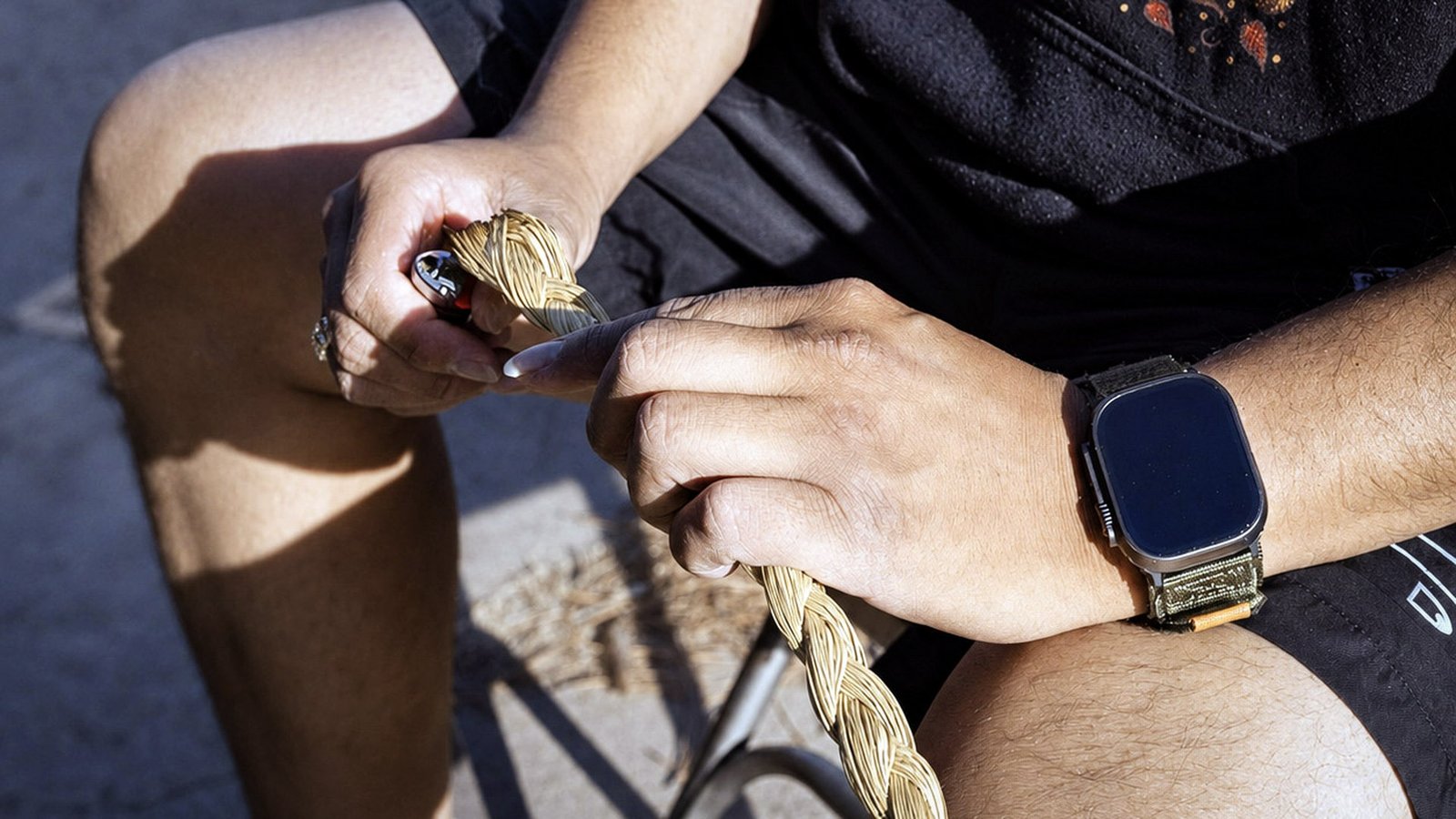
The second is a pair of hands in Oklahoma. Wichita is lighting a braid of sweetgrass, smoke lifting off the end, and on his wrist is an Apple Watch. Some people would want that watch gone, as if it spoils something ancient. I think it is the most honest object in the picture. His chapter has a section called "Living It, Not Wearing It," and the watch is how you know he lives it now, in this century, on a day with a schedule.
The third is Matt at his desk in San Diego, mid-sentence. Blinds behind him, shelves, a woven textile, a framed photograph, a row of books, a framed note. I wrote about his place in the book: "Inside, the walls are an inventory." Clearing that desk would have erased the inventory, and the inventory is the man.
The fourth is a tattoo booth at Stop the Hate in the 918. A roll of paper towels, ink bottles, a red toolbox, cords running everywhere, two men laughing while a hate tattoo disappears under new work. A clean version of that scene would be a lie about what it takes. The event is a gymnasium full of folding tables and borrowed time. The mess is the evidence.
What the mess earns
Trust. Real details build it in a way a viewer feels before they can explain it. Pam, whose chapter is about her headshot work, notices "the oddities, the messed-up hair, the thing that shouldn't be," because noticing is how people feel seen. The same is true for whoever looks at the photograph later. One unplanned object tells them the rest was not arranged either.
The clearest version of this is at the end of a gravel road in Missouri, where dolls hang from the trees on the way in. They are unsettling, and they are the first thing you see. They stayed in the chapter, because they were true: "Reaching the end of the driveway did not erase the dolls. It made the picture larger."
Where judgment comes in
None of this means anything goes. If something in a frame would expose a person who did not agree to be exposed, I deal with it honestly. I reframe, I choose another image, or I don't publish that one. What I don't do is remove it and present the result as untouched.
That is the line. Protecting someone is a decision I can explain. Polishing someone is a claim I can't support.
So the bottle stays. The watch stays. The paper towels stay. Leave them in, and the picture gets larger.
Resonance arrives November 10, 2026. Join the early list for cover reveals, excerpts, and release-day news.
Join the early list