Storytelling & Communication · Field Notes · October 8, 2026 · 5 min read
The Number They Wanted
Two hundred ninety-four trees went into the ground in Kobusinge. It's a true number and a good one. So why does it say so little about what actually happened there?
The Number They Wanted
If you ask me what happened in Kobusinge, I can give you a number. Two hundred ninety-four.
That's how many trees went into the ground the day Agri Planet Africa opened its second Community Permaculture Resource Center. It's a good number. It fits on a slide, and it's true. I can even break it down for you: 153 Melia azedarach along the boundaries, 52 eucalyptus for windbreaks, 43 pawpaw, 40 banana, six jackfruit. If a funder wants to know what their money did, 294 is the answer they're hoping for.
But that number has been sitting with me for a while now, and the longer it sits, the less it seems to say.
What the number leaves out
It doesn't tell you the boundary trees were chosen because they grow fast enough to become a living fence. Or that the pawpaw was planted for fruit and income within two years, and the eucalyptus for timber long after anyone remembers who dug the hole. The count treats a jackfruit and a sapling meant to keep goats out as the same unit. They aren't. Each one is a decision about a different future.
It doesn't tell you about the conversation under the mango tree, where community members talked about seed fraud. They'd bought seeds that never sprouted and lost whole seasons to it. Agri Planet's answer was a seed bank: borrow good seed, repay the same amount at harvest, a little extra if you can. You could count the bags of seed. You couldn't count the trust that makes someone willing to borrow again next year, and that trust is the whole program.
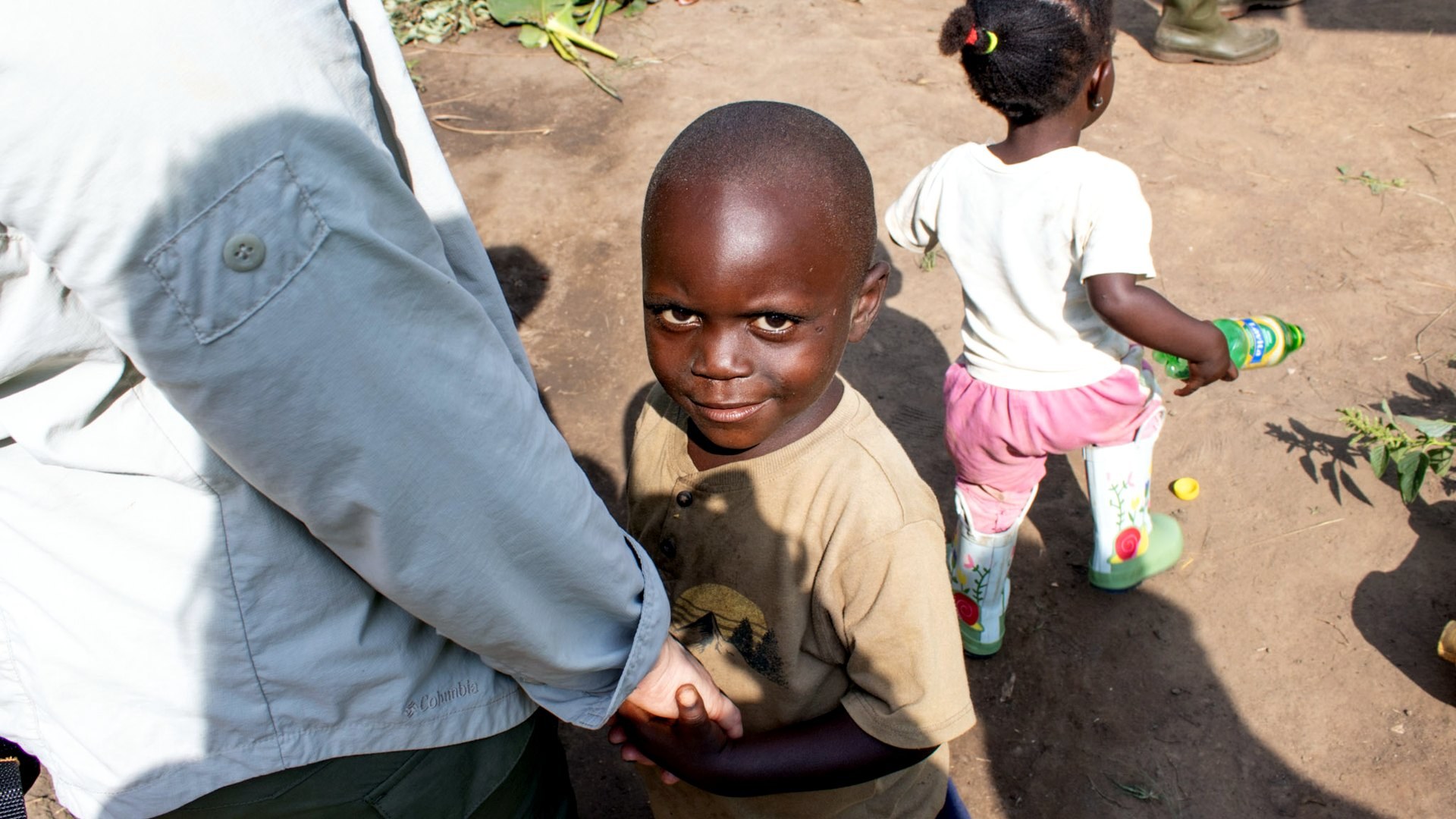
And it doesn't tell you about the small boy who stood quietly at the edge of the celebration and slipped his hand into mine. I don't know how you'd report that. I'm not sure you should. But I know it's part of why that land will be cared for.
Why institutions need one number
I don't want to be unfair to the people asking. I've worked in strategic communication long enough to understand why the number exists. A board has twenty minutes. A donor is comparing you to dozens of other organizations. A grant officer has to defend a decision to someone who has never been to Masindi. One number travels. A story doesn't fit on a dashboard.
The trouble isn't that we measure. It's what happens after we've measured the same thing for a while. The number starts shaping the work. If trees planted is the metric, you plant trees, and you get very good at planting trees. Maybe you stop asking whether they were the right trees, or who will water them in a dry season, or whether the teacher who learned seedling spacing from Cleofash that afternoon will pass it on to her students next term.
Those are the outcomes that matter. They just happen too slowly, and too far from the spreadsheet, to show up in a quarterly report. What's easiest to count and what matters most are rarely the same thing. Most of us know this. We report the easy thing anyway, because that's what the form asks for.
A funder who asked a different question
There's a story in Fields of Resilience I come back to often. During the pandemic, Agri Planet launched a mushroom cultivation project to bring food and income to orphanages. Then supply chains broke down, and the project, as designed, stopped working.
By most measures, that's a failure. The deliverable didn't get delivered.
But one orphanage took what it had learned and reimagined its own future. It moved toward growing maize and bringing the children into hands-on agricultural learning, shifting from dependency toward sustaining itself. The funder behind the work, the Evolutionary Funding Collaboratory, was built for exactly that kind of turn. It valued what people learned along the way over a fixed list of outputs. So the "failed" project became the start of something sturdier than the original plan.
I think about how that would have looked on a standard report. Mushrooms harvested: not many. What a community learned about adapting when the ground shifts under it: nearly everything. Only one of those has a box.
The number that hurts
There's a photo in the book of a refugee student at Kyangwali, kneeling with a basketball, lit up with the kind of joy you can't stage. By the time I wrote her caption, she was no longer in school.
Somewhere, she's been counted. She's a fraction in a dropout rate for adolescent girls in refugee settlements, and that rate is real and urgent and worth tracking. But a rate can't hold her laugh. It can't tell you which of the pressures pushing girls like her out of school (poverty, early marriage, the weight of work at home) was the one that finally won. I wrote then that behind every dropout statistic is a soul full of life. I still believe it. The statistic tells us something is wrong. Only the story tells us what to do about it.
What I'm trying to practice
I'm not arguing for throwing the numbers out. Two hundred ninety-four trees matters. So does the dropout rate. Numbers are how we notice patterns we'd otherwise miss, and how we keep ourselves honest.
What I'm trying to practice, in my own reporting and in the work I do for others, is refusing to let the number stand alone. Pair it with one person's account. Report what changed, not only what was produced. Leave room for "here's what we learned when the plan stopped working." And when someone asks me for the one number, give it to them, then ask if they have five more minutes.
Joshua was eleven when war reached his village in eastern Congo and he came home to find his parents gone. Years later, at CIYOTA, he wrote something I keep close: "Support if you can, because what you call small may turn someone's pages to white—and help them start a new chapter."
What you call small. That's what a single metric does, almost by design. It makes things small so they'll fit. The real work is remembering how big they were.
Resonance arrives November 10, 2026. Join the early list for cover reveals, excerpts, and release-day news.
Join the early list